.svg)


.svg)


%20(1)%20(1).webp)
Topic
Text
Satellite data and Earth Observation provide critical insights into how climate change is transforming mountain ecosystems. Through the MOUNTAINEER project, high-resolution imagery and advanced geospatial analytics uncover glacier retreat, vegetation stress and slope instability, enabling targeted strategies for climate resilience, sustainable mountain preservation and effective alpine restoration.
Article
Content
The Impact of Climate Change on Mountain Ecosystems
Mountain regions are highly sensitive environmental systems that play a central role in global ecological stability. They regulate water availability for downstream communities, host substantial biodiversity, and influence regional climate dynamics. Their steep environmental gradients and extreme local variability make them especially responsive to atmospheric and land‐use changes, turning them into critical observatories of global warming.
In recent decades, climate change has accelerated a series of transformations that are reshaping the structure and functioning of alpine environments. One of the most visible indicators is the rapid decline of snow and ice. Rising temperatures are driving earlier snowmelt, altering accumulation patterns, and contributing to the retreat of glaciers across virtually all major mountain ranges. This process not only reduces long-term water storage but also disrupts the timing and quantity of water flows that sustain agriculture, hydropower and ecosystems far beyond mountain borders.
Vegetation dynamics are also undergoing significant shifts. Warmer conditions are pushing treelines upward, enabling the expansion of shrublands and altering forest composition. These shifts affect habitat distribution, soil stability and carbon sequestration capacity. In parallel, changes in precipitation regimes and increased frequency of droughts heighten the vulnerability of mountain forests to pests, wildfires and decline events. Studies from Alpine regions highlight that these pressures are already reducing forest productivity and modifying ecosystem services that local communities rely upon.
Soil and geomorphological processes respond rapidly as well. Permafrost thaw, increased rainfall intensity and reduced vegetative cover contribute to slope instability, debris flows and erosion. These processes elevate natural hazard exposure for settlements and infrastructure located along valley corridors. In many regions, climate impacts intersect with socio-economic drivers such asdepopulation, tourism pressure and land abandonment, amplifying degradation and complicating conservation strategies.
Because mountains integrate atmospheric, hydrological and ecological processes, climate-driven alterations propagate across entire landscapes and downstream basins. Understanding these dynamics is therefore essential for designing effective adaptation, mitigation and restoration strategies. As climatic trends intensify, the need for continuous, quantitative, and spatially explicit monitoring becomes a cornerstone of any long-term approach to mountain preservation and climate resilience.
How Satellite Data Enhance Mountain Monitoring and Climate Resilience
Satellite-based Earth Observation has become an essential pillar for understanding and managing the rapid transformations occurring in mountain environments.
Unlike traditional ground-based measurements—often limited by accessibility, weather constraints and sparse monitoring networks—satellite data provide continuous, repeatable and spatially extensive observations capable of capturing the inherent complexity of alpine systems. This capacity is particularly valuable in regions where steep gradients, heterogeneous landforms and microclimatic variability demand high-resolution and temporally consistent information.
Modern satellite platforms deliver a broad spectrum of geospatial products. Optical and multispectral sensors allow detailed mapping of snow cover, glacier extent, vegetation health and land-use changes. Radar missions, unaffected by cloud cover or illumination, support the detection of ground deformation, permafrost instability and slope dynamics. High-resolution imagery enables the identification of fine-scale features such as rockfall scars, erosion patterns and forest structural changes, all of which are critical indicators of climate-driven stress.
These datasets address major gaps in existing ESG and environmental management approaches. Mountain regions often lack comprehensive baselines and continuous monitoring systems, making it difficult to quantify risk exposure, track ecosystem degradation or evaluate the effectiveness of restoration strategies. Satellite data overcome these limitations by offering objective, standardised measurements that can be compared across seasons and years, creating robust time series essential for climate resilience planning. For instance, long-term observations of glacier retreat or snowpack variability help anticipate water resource imbalances, while vegetation indices derived from multispectral sensors reveal early signs of forest stress, pest outbreaks or biomass decline.
Satellite information also supports integration across disciplines. Hydrology, geomorphology, ecology and climate modelling increasingly rely on geospatial inputs derived from Earth Observation to calibrate algorithms, validate simulations and produce scenario-based assessments. This multidisciplinary integration strengthens the analytical capacity of mountain monitoring frameworks and enables decision-makers to connect environmental change with socio-economic implications such as water security, natural hazard exposure and the sustainability of mountain landscapes.
Moreover, the interoperability of satellite datasets—facilitated by open standards, cloud-based processing environments and automated geospatial workflows—allows organisations to embed continuous monitoring directly within their ESG strategies. By supplying consistent evidence of climate impacts and environmental trends, satellite data enhance transparency, accelerate reporting processes and support compliance with emerging sustainability regulations.
In this context, satellite-driven analytics are not merely a source of information but a strategic tool for anticipating climate risks, designing adaptive measures and reinforcing long-term mountain resilience.
The MOUNTAINEER Project: A Model for Digital and Sustainable Mountain Preservation
MOUNTAINEER is an applied research initiative developed within the NODES Innovation Ecosystem to advance new methodologies for monitoring and safeguarding mountain environments. Conceived as a multi-actor collaboration, the project brings together Latitudo 40, Stratobotic, academic research groups and territorial stakeholders from the Aosta Valley to build a scalable framework for generating high-quality environmental intelligence in complex alpine settings. Its central objective is to validate an integrated observation system capable of combining stratospheric platforms, satellite data and advanced geospatial analytics to support climate resilience strategies.
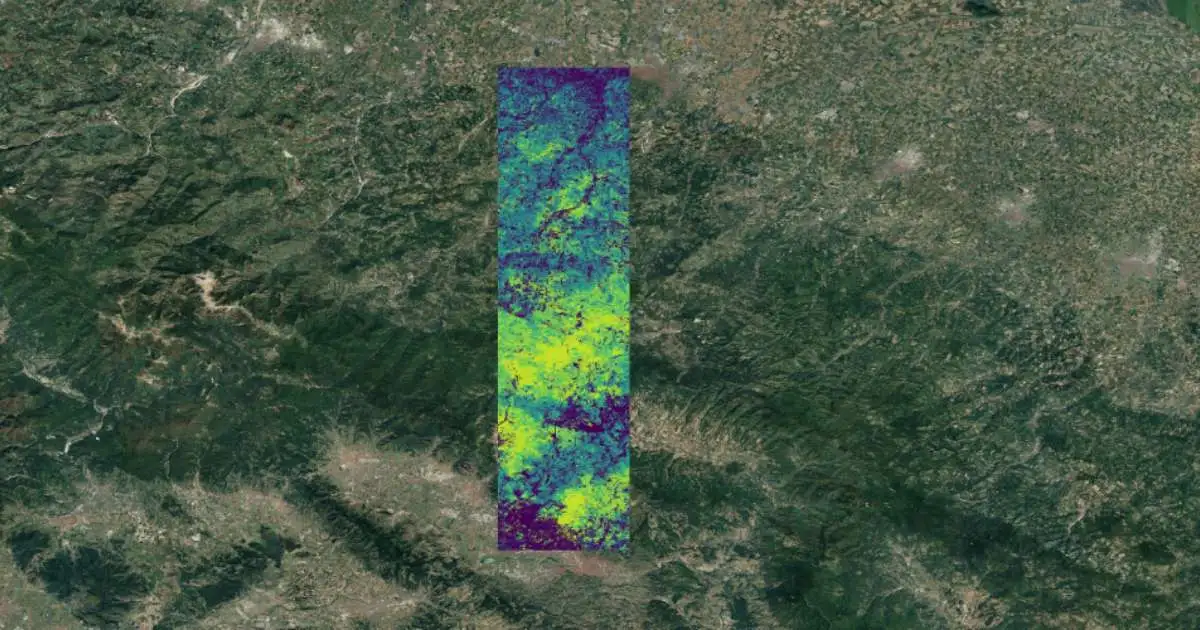
A key feature of MOUNTAINEER is the use of high-altitude stratospheric flights conducted by Stratobotic with CubeHAPS platforms. These missions, executed over the Cogne valley during July and August 2025, enabled the acquisition of high-resolution RGB and multispectral datasets under real operational conditions. The multispectral sensor captured ten spectral bands optimised for vegetation and land-surface analysis, while the dual RGB configuration allowed the generation of dense image overlap and accurate 3D reconstruction without the need for ground control points—an essential capability in remote or inaccessible mountainous terrain. All flights were accompanied by GNSS-RTK telemetry to ensure precise geolocation and to support downstream photogrammetric processing.
Latitudo 40 contributed the digital backbone of the project, integrating the raw stratospheric acquisitions with satellite observations from Sentinel-2 and processing them through a full analytical workflow. This included the creation of orthomosaics, digital elevation models, vegetation indices and thematic layers covering hydrology, geomorphology and land-cover dynamics. The validation phase demonstrated the interoperability of stratospheric and satellite datasets, confirming that their combined use can generate accurate, consistent and repeatable geospatial products suitable for environmental monitoring over large and morphologically complex areas.
The project’s governance model also places strong emphasis on stakeholder participation. Regional authorities, environmental agencies, research institutions and local operators were involved throughout the design, analysis and feedback phases. Their contributions ensured that workflows, data products and operational scenarios aligned with real management needs, ranging from forest monitoring and hazard assessment to water resource planning and landscape conservation.
By integrating multi-source Earth Observation data, high-resolution acquisitions and cloud-native geospatial infrastructure, MOUNTAINEER offers a replicable blueprint for digital mountain preservation. It demonstrates how advanced EO technologies can support evidence-based environmental policies, enhance situational awareness and enable sustainable decision-making in regions most exposed to climate change.
Key Findings: What Earth Observation Reveals About Alpine Vulnerability
The combined use of stratospheric imagery and satellite-based Earth Observation within the MOUNTAINEER project generated a comprehensive picture of how climate stressors are reshaping alpine systems. The two acquisition campaigns conducted over the Cogne valley—one multispectral flight in July 2025 and a dual-platform RGB mission in August 2025—provided high-resolution datasets covering nearly 200 km² of mountainous terrain. These acquisitions, processed and validated through Latitudo 40’s analytical workflow, produced detailed orthomosaics, digital elevation models, vegetation layers and hydrological maps that reveal the environmental dynamics underlying alpine vulnerability.
A first set of insights concerns glacier and snow dynamics. Although the flights occurred during summer, the multispectral dataset enabled the identification of residual snow patches, meltwater corridors and high-albedo zones indicative of accelerated seasonal melting. When cross-referenced with Sentinel-2 observations, these patterns aligned with longer-term trends showing progressive reduction of snow persistence and earlier melt-out cycles, a key driver of hydrological imbalance in Alpine catchments.
Vegetation health and forest structure emerged as another critical dimension. The multispectral sensor allowed the computation of several vegetation indices—including NDVI, SAVI, NDWI, NDRE and GNDVI—highlighting spatial variability in canopy vigour, moisture stress and regeneration capacity. These indicators revealed zones where shrub encroachment is expanding, areas exhibiting early symptoms of drought-driven decline, and gradients consistent with upward shifts of vegetation belts. The RGB flights, supported by precise GNSS-RTK geolocation, provided detailed texture and structural information essential for assessing forest continuity, fragmentation and susceptibility to slope processes.
Terrain morphology was equally informative. The integration of dense image overlap, photogrammetric modelling and digital elevation reconstruction produced high-quality DEMs and DTMs, allowing the extraction of slope, aspect, hillshade and curvature layers. These morphological parameters made it possible to identify potential instability hotspots, including steep sectors prone to debris flows, eroding ridgelines and areas where permafrost degradation may amplify slope hazards. Combined with hydrological derivatives—such as drainage networks and flow accumulation maps—the project delivered a refined understanding of how climate-driven changes intersect with geomorphological processes to increase exposure to natural hazards.
Validation results further demonstrated the reliability of stratospheric data for operational use. The RGB datasets achieved metre-level positional accuracy, while multispectral classifications showed strong coherence with Sentinel-2 when harmonised at comparable resolutions. This confirms that high-altitude acquisitions can complement satellite time series with finer-scale detail, enabling both temporal continuity and spatial precision in sensitive alpine landscapes.
Overall, the findings illustrate that Earth Observation does more than document environmental change: it uncovers the mechanisms shaping alpine vulnerability. By translating raw multispectral and RGB data into actionable indicators—glacier retreat signals, vegetation stress patterns, instability zones and hydrological shifts—MOUNTAINEER provides decision-makers with the analytical foundation needed to anticipate climate impacts, prioritise interventions and strengthen long-term mountain resilience.
Turning Insight into Action: Using Satellite Intelligence for Adaptation, Mitigation, and Alpine Restoration
Transforming Earth Observation outputs into actionable strategies is central to building climate-resilient mountain regions. The integrated datasets produced through MOUNTAINEER demonstrate how satellite intelligence, enhanced by stratospheric imagery and high-resolution analytics, can support decision-makers in designing targeted interventions across adaptation, mitigation and ecosystem restoration domains.
For adaptation planning, continuous EO monitoring enables authorities to identify emerging vulnerabilities before they evolve into critical risks. High-precision DEMs and slope maps support the early detection of instability zones, guiding the prioritisation of protective measures on trails, transport corridors and inhabited areas. Vegetation indices derived from multispectral data reveal where forests are experiencing stress or reduced biomass, allowing managers to tailor silvicultural practices, anticipate pest outbreaks and reinforce natural protective barriers. Similarly, hydrological layers based on snow cover, moisture conditions and drainage patterns help model water availability under shifting climate regimes, informing reservoir management and downstream allocation policies.
Mitigation strategies also benefit from systematic satellite monitoring. Vegetation and land-cover indicators provide quantitative metrics for carbon stock assessments, enabling regions to refine greenhouse gas inventories and track the effectiveness of forest management or reforestation programmes. Long-term glacial and snowpack observations contribute to climate reporting frameworks and support compliance with ESG disclosure requirements by providing verifiable evidence of environmental trends.
Restoration efforts, particularly in degraded alpine zones, are strengthened by the availability of high-resolution baseline data. Stratospheric and satellite imagery facilitate the identification of eroded slopes, fragmented habitats and areas experiencing vegetation retreat. These insights enable the design of restoration actions—such as reforestation, slope stabilisation or hydrological regeneration—with clear spatial prioritisation and measurable ecological outcomes. Post-intervention monitoring can then be automated via periodic EO updates, ensuring ongoing evaluation of restoration success.
By integrating satellite-derived intelligence into operational workflows, mountain regions can move from reactive management to proactive climate governance. MOUNTAINEER demonstrates that scalable, interoperable geospatial data infrastructures provide the analytical foundation necessary to implement evidence-based adaptation, support mitigation goals and accelerate the restoration of fragile alpine ecosystems.
_11zon.webp)

.webp)