.svg)


.svg)


%20(1)%20(1).webp)
Topic
Text
Satellite data and AI enable advanced flooding risk assessment by identifying flood-prone areas across fluvial, pluvial, and coastal scenarios and quantifying potential economic losses. The Latitudo40 Flooding Risk Assessment layer delivers high-resolution flood risk analysis at asset and portfolio level, supporting insurance underwriting, flood risk management, flood mitigation planning, and disaster management with scalable, data-driven insights in a climate-exposed environment.
Article
Content
Global overview of flooding and its growing impacts
.webp)
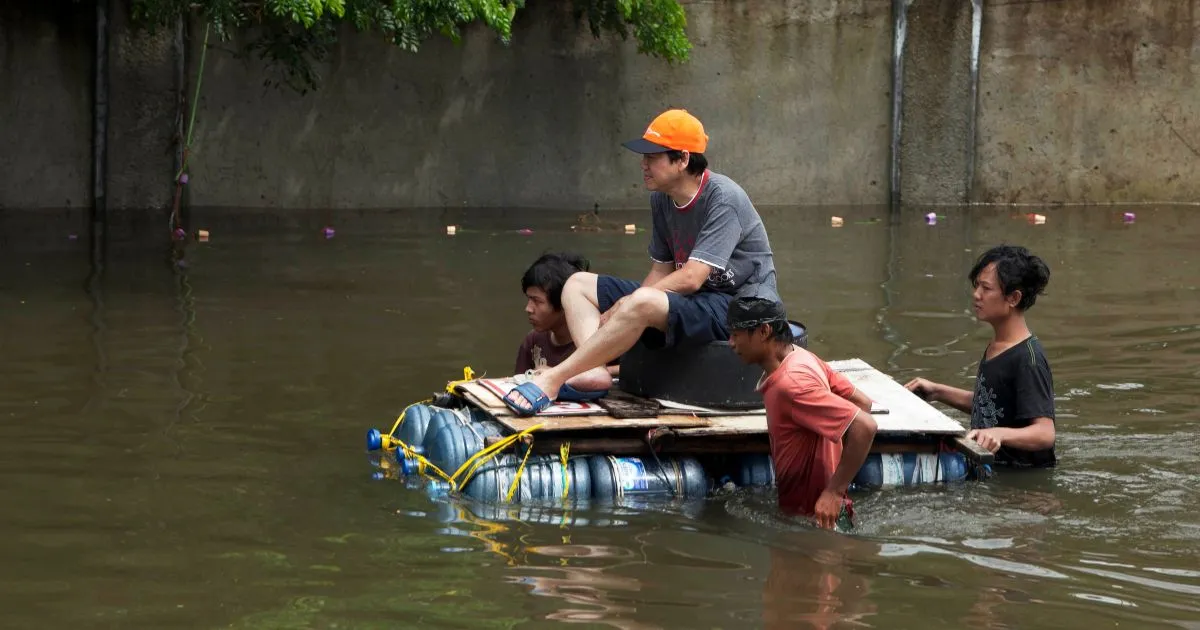
Flooding is a leading natural hazard worldwide, affecting over 100 million people annually and causing economic losses exceeding $60 billion per year. Historical trends show a steady increase in both frequency and intensity of flood events, with the number of reported floods rising by nearly 40% over the past two decades. Regions most exposed include South and Southeast Asia, Europe’s river basins, and low-lying coastal areas vulnerable to storm surges.
Notable recent events include the 2025 floods in Pakistan, which displaced millions and caused over $14 billion in damages, and the 2025 floods in Western Europe, which resulted in hundreds of fatalities and widespread infrastructure damage.
The primary flood types—fluvial, pluvial, and coastal flooding—pose distinct challenges in terms of hazard prediction and mitigation. These trends, exacerbated by climate change, underscore the critical need for advanced flooding risk assessment and flood risk management tools to support proactive disaster management strategies.
Types of flooding and drivers of flood risk
Flood events can be classified into three main types, each with specific mechanisms and implications for flooding risk assessment:
- Fluvial flooding:
Caused by rivers overflowing their banks due to prolonged rainfall or rapid snowmelt; primarily affects communities along river basins and agricultural land.
- Pluvial flooding:
Triggered when intense rainfall exceeds the capacity of urban drainage systems or low-lying terrain, causing localized inundation even far from rivers.
- Coastal and marine flooding:
Driven by storm surges, tidal extremes, and sea-level rise, posing significant threats to low-lying coastal zones and infrastructure.
Key drivers of flood risk include topography, soil permeability, land use, hydrological connectivity, and urbanization patterns. Extreme weather events, intensified by climate change, amplify flood frequency and severity, expanding the flooding area and increasing potential economic and human losses. Understanding these factors is essential for accurate flood risk analysis and effective flood risk management, supporting targeted flood mitigation strategies and proactive disaster management.
Current limitations in traditional flood risk assessment methodologies
Traditional flooding risk assessment approaches rely heavily on historical records, hydrological models, and ground-based observations. While these methods provide valuable insights, they present several limitations that can affect the accuracy of flood risk analysis.
%20(1).webp)
- Limited spatial coverage: Ground measurements and historical data often cover only specific regions, leaving large areas without reliable flood information.
- Temporal gaps: Historical records may not capture recent changes in land use, urbanization, or climate patterns, reducing predictive reliability.
- Simplified modeling assumptions: Many hydrological models assume static terrain or uniform rainfall distribution, which may not reflect complex flood dynamics in urban or coastal environments.
These limitations hinder effective flood risk management, as inaccurate or incomplete data can lead to underestimation of the flooding area and potential damages. They also constrain flood mitigation planning, making it difficult to prioritize interventions or allocate resources efficiently.
The growing complexity of flood events, driven by climate change and rapid urban expansion, underscores the need for advanced, data-driven approaches. Integrating high-resolution, near-real-time data sources can overcome these gaps, enabling more precise disaster management and proactive flood mitigation strategies.
Satellite data for flooding risk assessment and flood risk analysis
Satellite Earth Observation (EO) has transformed the way flooding risk assessment and flood risk analysis are conducted, offering unprecedented spatial coverage, high frequency updates, and objective measurements across diverse geographic regions. Unlike traditional methods that rely on sparse ground-based observations, satellite imagery provides consistent, near-real-time data even in remote or inaccessible areas, improving the monitoring of flooding areas and hazard dynamics.
Optical and radar sensors serve complementary roles: optical imagery captures land cover, urban expansion, and river morphology, while radar sensors penetrate cloud cover and provide precise flood extent detection during extreme weather events. Combined with digital elevation models and hydrological data, these observations enable a detailed understanding of water accumulation, flow pathways, and vulnerable terrain.
.webp)
Integrating satellite data with AI-driven analytics allows for dynamic mapping of flood-prone zones, quantifying exposure and potential impacts. High-resolution EO data supports both flood risk management and disaster management by informing early warning systems, guiding emergency response, and facilitating post-event damage assessment. It also enhances flood mitigation strategies by identifying critical infrastructure and urban areas at risk, helping planners prioritize interventions and resource allocation.
In addition, satellite-based analysis can be scaled globally, providing standardized metrics for cross-regional comparisons and longitudinal studies of flood trends. By combining temporal series of satellite observations with advanced modeling, organizations can anticipate flood recurrence, estimate potential economic losses, and design more resilient adaptation measures.
Overall, satellite EO is a cornerstone of modern flood risk assessment, enabling more precise flood risk analysis, improved situational awareness, and data-driven support for both public authorities and private-sector stakeholders involved in flood risk management and climate adaptation.
Latitudo 40's Flooding Risk Assessment layer
The Latitudo40 Flooding Risk Assessment layer delivers an advanced, satellite-based solution designed to support high-precision flood risk analysis and decision-making across complex geographic contexts. Built on high-resolution Earth Observation data and AI-driven geospatial modeling, the layer provides a comprehensive view of flood hazard across fluvial, pluvial, and coastal flooding scenarios.
.webp)
The layer combines detailed flood hazard metrics—such as flood extent, depth, and relative risk—with spatial exposure data to assess how different flooding areas may be impacted under specific scenarios and return periods. This enables users to move beyond qualitative hazard mapping and adopt a quantitative flooding risk assessment approach, grounded in objective, spatially consistent data.
A key strength of the solution is its ability to translate flood hazard into economic impact. By intersecting flood risk outputs with assets such as buildings, roads, and critical infrastructure, the layer supports the estimation of potential damages and loss distributions. This capability is essential for evaluating risk concentration, identifying hotspots, and prioritizing flood mitigation measures.
Designed for scalability and interoperability, the Flooding Risk Assessment layer can be applied at asset, portfolio, or territorial level, supporting both localized assessments and large-scale analyses. It enables continuous monitoring of flood risk evolution over time, strengthening flood risk management strategies and enhancing preparedness within broader disaster management frameworks.
By transforming satellite data into actionable flood risk intelligence, Latitudo40 empowers organizations to anticipate impacts, reduce uncertainty, and build more resilient responses to flooding in an increasingly climate-exposed world.
Assessing exposure and economic damage across buildings and infrastructure
The Latitudo40 Flooding Risk Assessment layer applies AI-driven geospatial algorithms to perform advanced flooding risk assessment at asset level, enabling a structured analysis of exposure and potential economic damage across different categories of buildings and infrastructure. By integrating satellite-derived flood hazard metrics with asset classification models, the layer delivers differentiated flood risk analysis tailored to the characteristics of each asset class within a flooding area.
The system classifies exposed assets into distinct categories, including:
.webp)
- Residential buildings, where flood depth and frequency are used to estimate structural damage and expected losses.
- Commercial and industrial buildings, characterized by higher asset values and increased vulnerability to operational disruption.
- Transport infrastructure, such as roads, bridges, and railways, where flood exposure affects connectivity and economic continuity.
- Critical infrastructure, including energy, water, telecommunications, and healthcare facilities, essential for emergency response and recovery.
For each class, AI models apply specific vulnerability and loss functions to translate physical flood impacts into estimated economic damage. This class-based approach supports more accurate loss quantification and enables scenario comparison across territories and portfolios. By delivering granular, asset-specific insights, the Latitudo40 layer strengthens flood risk management, supports targeted flood mitigation actions, and enhances decision-making within broader disaster management frameworks.
Applications in insurance, flood risk management and disaster mitigation
The Latitudo40 Flooding Risk Assessment layer is designed to address the operational and analytical needs of insurance companies, risk managers, and public authorities involved in flood risk management and disaster management. By combining satellite data, AI-driven flood modeling, and economic loss estimation, the layer supports data-driven decision-making across the full risk lifecycle: from underwriting and portfolio management to preparedness, response, and mitigation.
In the insurance sector, the layer enables advanced flooding risk assessment at both asset and portfolio level. Insurers can integrate flood hazard, exposure, and damage metrics into underwriting processes to accurately price flood-related risk, identify high-risk flooding areas, and reduce uncertainty in coverage decisions. The ability to quantify expected economic losses under different flood scenarios supports probabilistic flood risk analysis, reinsurance structuring, and capital allocation. In addition, satellite-based, standardized data improves consistency across geographies, enabling insurers to manage geographically diversified portfolios and comply with increasing regulatory and ESG-related disclosure requirements.
.webp)
For flood risk management, the layer provides a robust analytical framework to identify risk hotspots, assess vulnerability of buildings and infrastructure, and prioritize flood mitigation measures. Public authorities and infrastructure operators can use these insights to plan interventions such as drainage upgrades, river management actions, or nature-based solutions, optimizing investments based on quantified risk and potential damage reduction. Continuous monitoring also allows stakeholders to track how urban development, land-use change, or climate-driven hazard evolution affects flood exposure over time.
Within disaster management and flood mitigation, the Latitudo40 layer supports proactive planning and preparedness by enabling scenario-based analysis of flood impacts before events occur. By identifying critical infrastructure and highly exposed communities within a flooding area, decision-makers can strengthen emergency planning, improve early warning strategies, and allocate resources more effectively. Post-event, the same framework can be used to support rapid damage assessment and recovery planning, ensuring continuity between preparedness, response, and long-term resilience building.
By transforming satellite observations into decision-ready flood intelligence, the Latitudo40 Flooding Risk Assessment layer empowers insurers, risk managers, and institutions to anticipate flood impacts before losses occur. From underwriting and portfolio optimization to flood mitigation planning and disaster management, the solution delivers quantifiable insights on flooding areas, economic exposure, and risk concentration.
This enables organizations to reduce uncertainty, improve risk selection, and allocate capital and mitigation investments more effectively. As climate-driven flood risk accelerates, Latitudo40 provides a scalable, data-driven foundation for resilient insurance strategies and proactive flood risk management.
_11zon.webp)

.webp)